Monday, 19 July 2010

Central Library, Edinburgh

After the National Library our class visited the Central Library just across the street.  The difference here is that the Central Library is a public lending library, not a depository library.  The Web Site presents the library as more modern than others we have visited in the U.K in terms of online resources and availability.  On the tour, however, we were shown the living card catalog.  Online they offer "some things you can't find on google" especially in terms of business resources (http://yourlibrary.edinburgh.gov.uk/libraries-mean-business).  I thought this was interesting because at home I frequent a business resource center http://www.millerbusinesscenter.org/bizlink.html through a local public library, and it has been very valuable.  According to one librarian, the government is trying to get the general public to use the internet for an array of services, and is accomplishing the task of teaching "web 2" through local libraries. 


The tour was very thorough and offered a behind-the-scenes view of a busy library.  There are over 38 different book groups that are active at this location.  Librarians participate in continuing education called Front Line- a three year online training program.  Volunteers make personal house calls to patrons that are home-bound.  The library collaborates with many organizations like the Storytelling Center and the Scottish Book Trust to expand the library environment and connect with the public. 


Special Collections material is held in the Edinburgh Room, Fine Art, Music, Reference and Scottish Departments of the Central Library building.  The history of Scotland is represented through rare or unique books, manuscripts, illustrations and photos.  On our tour we were shown some rare children's books, however it was a very quick glimpse and they were behind closed doors again. 

Most preservation work is out sourced.  There is no conservation studio in the library, which is generally the case in a public library of this type.  To conserve items, they are placed in acid free boxes or envelopes to prevent wear and tear.  Certain items can not circulate although most special collections can be utilized in the library reading rooms.  Special collections does not always mean ancient items, but can include materials right up until today that are rare or unique.

It doesn't seem like much has changed since last year, but then again where improvements are taking place- it is behind the scenes in terms of professional training and online with collection development and cataloging.  In the music library I saw a sign for LGBT Glee; which I have never seen anything like it before.  Sounds like a very interesting program and a good way to draw in more diverse members of the public.  


Visit http://www.edinburgh.gov.uk/internet/leisure/libraries/your_nearest_library/Central%20Library to find out more information on their services.

National Library of Scotland

 Dark photo from inside the John Murray Archive exhibit


. 

Although we did not have a formal tour of the library, there was a new exhibit on the John Murray collection. John Murray I developed a publishing firm on Fleet Street in 1786.  Over 1,000 titles were published and that was only the beginning.  His son, John Murray II took over the business when he was only 15.  He launched the firm into a more prosperous and renowned business.  Murray held literary meetings that Sir Walter Scott coined "Murray's 4 o'clock friends". This was grounds for the start of the 1824 literary group The Athenaeum Club.  Murray II's wife inherited the archival collection.


The John Murray Archive collection displays over 200 years of manuscripts, letters, and history.  Display cases exhibit noteworthy items from Charles Darwin, Jane Austen, Conan Doyle's Sherlock Holmes, Lord Byron, David Livingstone and more.  Interactive computer monitors highlight and then describe items as you select each one. They were mostly academic, although I was amused by the comparison of Lord Byron to modern day Prince.

There is a great interactive timeline of the archives on their Web Site, http://www.nls.uk/jma/timeline/index.html.


There was also an exhibit on the history of golf that I found very interesting.  The floor space was set up complete with putting greens and flags.  At the entrance, patrons can pick up a golf score card that will guide them through the exhibit.

The library has a General Reading Room, Music and Rare Books Reading Room, Manuscripts Reading Room and a Multimedia Room.  The collection started in 1680s although the library did not open until 1689. Over 490 languages are represented although the main focus is the study of Scotland and Scots.  Every subject is covered and the collection spans 110 miles of shelving.  Their preservation department has a division called The Reprographic Unit that maintains the collection at all phases from storage, exhibition, transportation and patron use.  This would be a very interesting department for the class to visit.   You can place orders for images at http://www.nls.uk/info/copyingservices/

Visit their site at http://www.nls.uk/

Friday, 16 July 2010

John Harvard Library, Southwark

Public Library
Burough High Street (London Bridge tube station)


This library is a popular public library with many innovative features.  There is a local exhibit and Local Record Office, cafe area with a flat screen TV, large reading room and social area and over 25 public computers.  Items are divided by topic and arranged for browsing.  It is very easy to navigate the library, and staff is very accommodating.  In general this seems very similar to public libraries in NY, maybe more multi-cultural because of the city environment.  There is a huge section of Bollywood DVDs, which I am now a new fan of!  

In order to meet current demands, every Southwark library offers the top 20 fiction and non-fiction books in addition to PS3 games.  I have noticed that libraries in the UK do not offer Wii games and/or events like in the states.  The library charges £2 per inter library loan and for scores.  

The Local History Library Collection includes books, photographs, maps, newspapers, videos, tapes and archives. A selection of photographs can be viewed at www.southwarkcollections.org.uk. The site is a work in progress, for example the exhibits page is not yet available.  The entire collection is not online yet, however it claims to be updated daily.  The e-museum is pretty interesting and combines the highlights from three different collections.


This is in between the social area and the children's section.  I've noticed parents give their children more independence in the UK, and this is one example.  Parents have tea in the cafe, read or watch TV while the kids do their own thing.  This is a great introduction to the library environment for children.  They can develop a love for books on their own accord, and use their independence to gain confidence in themselves and in learning.  I love this reading area, I wanted to curl up in there with a book!  Reminds me of this big boat that I had in my school library growing up.  I really appreciate anything funky that can encourage reading in children. 


An array of services are available electronically.  Reserve a computer, pick up and pay for printed items, and check out books at self-service kiosks like this one.  Either type in the library card number or simply place your card inside the machine, and it will scan your entire account.  The library is equipped with RFID (radio frequency identification) allowing patrons to check out their items just by placing them on the counter, one on top of the other.  I have found that more libraries in the U.K. are adopting this method rather than those I use in NY.  This frees up staff to be able to rove and be more active with patrons on the floor. Plus I have to believe patrons enjoy scanning their own books, or is that just the librarian in me?!


This is the book drop outside of the library.  It caught my attention and I think it's a great way to attract patrons.  This is the only book drop I have seen that doubles as a small exhibit space.  It also advertises the library coffee mugs for sale!!  Great usage of space and a fun way to draw some attention.   In general, the library aims to provide a high level of information services while maintaining an innovative, modern edge. 


 John Harvard Library reopened in November 2009 after being closed for renovations for 13 months.  The Lottery-funded award of £1.4 allowed the library to completely revamp and offer the most modern resources.  According to an article from February 6, 2010 on a local Web Site for London SE1, "figures released last week show that 11,276 items (books, DVDs etc) were issued to borrowers in December 2009 compared to 7,115 in December 2007.  The comparative data shows that item issues have increased 58 per cent; visitors to the library have increased by 11 per cent and new borrowers are up by a tremendous 223 per cent".  (http://www.london-se1.co.uk/news/view/4329).  The article was really about a break in, where over 300 DVDs and games were stolen. 

Visit their site at www.southwark.gov.uk/libraries

People's Library, Kew Palace


Rear of palace...


Impressive collection of letters and documents to and from King George III


This is a short video (working on uploading!) to show the People's Library at Kew Palace, family home of King George III, Queen Charlotte and some of their 15 children! Dating from 1631, this site is truly impressive, not to mention pretty eerie. I think it's haunted! The library itself is very small, and not as much of a library as one would think of a current library.  What is so interesting is that the current famous collection at the British Library began in this palace.  The most prized books, however, are currently located at the Hampton Court Palace about 4 miles away.  Hope on the tube to the Hampton Court Station to visit this site (which I plan on doing, so stayed tuned!).  There are two display cabinets in the King's Private Drawing Room with the oldest book being the Historie by Guicciardin dating from 1579.


There are two interactive computers (one was out of order) and laminated placemat maps, as well as various books on the desks. There is a small collection of books in the library but only a few had dewey classification numbers on them. The remaining just had stickers indicating they were part of the People's Library. All of the books pertained to King George III, the Kew Palace and local history.  This library would be ideal for a class trip to teach children about the history of libraries and basic conservation.  It is very interesting to explore the Palace and then upstairs find this small library. 

I took a few photos of the "Hands On" boxes, and they were interesting to explore.  There was one I did not explore, it was geared towards attacking bugs. I learned some conservation tips that I was not aware of before...such as how to preserve items at home, how to handle old books and clean them. Most important: do not open a book if it is at all dusty. Gently clean it with a brush or if it is really dusty- a vacuum. Do not pull the book off the shelves from the top of the spine (like I always do, and I'm sure you do too).  Instead, gently push back the books on either side then firmly grasp the side of the book you want.  This will minimize wear and tear on the binding. 


Some conservation tools...
Four times a  year, conservators shine a torch light into the bookshelves to inspect the items and search for bugs or any other issues.  If anything is infested it is wrapped in polyethylene and frozen.  I never would have thought of freezing books, but this was also discussed at the British Library in terms of a solution for wet books. 


To join as a patron visit the Historic Royal Palaces' Web Site at http://www.hrp.org.uk/

Thursday, 15 July 2010

National Art Library

V&A Museum, National Art Library


Made up of over one million volumes, this closed access library offers books, manuscripts and periodicals on fine and decorative art, craft and design from all periods.  There is an online catalog detailing items acquired since 1987.    The Centre Room seats up to 20 readers, offers self-service copy  machines, digital cameras for rare/fragile items, and the Enquiry Desk.  The Reading Room, where you first walk in, has camera stands to hook up your own digital camera and is a silent room.  New patrons can attend an induction class that will show them how to navigate the library and its resources, reserve books, a seat and utilize the catalog. 


This exhibit outside the library is by Rintala Eggertsson and is called "Ark".  It is a giant wooden library tower.  I was immediately drawn to it, and would have stayed in there all day reading!! It reminded me of this wooden ship one of my school libraries had when I was growing up.  That is one of my favorite memories of reading and one reason I originally wanted to become a children's librarian.  So many good memories! 
The National Art Library does not use a classification system-they shelve by size because of the scope of their collection.  The goal is the preserve the collection rather than outsource for conservation.  Single issue items are usually outsourced for binding however funding is limited at a time like this and items are currently not being bound.  Items are not weeded which offers a comprehensive look at the history of art. To preserve items, there is a machine that creates a box or envelope to the specifications needed.  Enter the dimensions, and this machine will develop an acid free container to house the item for safe keeping. 

Currently the staff consists of about 30 members, however this number is decreasing.  Also decreasing is library space, as the museum tends to need gallery space for their increasing collection.  There is one gallery area that used the be all library space.  Shelves actually are locked to prevent the public from taking books down.  I thought this would increase circulation for the library but there are no statistics to indicate so.  The public going through the gallery can easily see there is a library available, which is a fact that could have been out of sight.  The only downside is that if a patron wants a book from that section, a librarian needs to get a screw driver to access the item! 

In viewing the special collections, I found myself sitting inches away from a Shakespeare first folio from 1623.  It contains all plays in one work and is considered the most authentic because it is by the Kings Players, those who actually performed the shows.


Is it:
A) art
B) a book
C) both?!

I didn't want to give it away, but it's both!  This item is a book sculpture made from a desk.


copyright skull and crossbones!


Visit them online at http://www.vam.ac.uk.nal


The V&A is one of my favorite museums. They have seven miles of gallery space, almost all free.  There are additional Study Rooms to get a closer look at items like the Prints & Drawings room, RIBA Architecture room, South & South-East Asia and Textiles study room.  Some are self-services, however most follow the closed access model of the main library.

Search the study room catalogs at http://www2.micromediauk.net/

Tuesday, 13 July 2010

London Library

The London Library is an independent arts and humanities library that dates from 1841.  It is the largest independent library in the world, and patrons pay a yearly fee to use the collection and resources.  Membership offers "affordable sustenance for the mind and the soul" and "stacks of inspiration".  Recently they have experienced a major renovation that increased their space by 30% and will allow for considerable growth for roughly the next 25 years.  This library has a wealth of history and key literary figures like Charles Dickens, Virginia Woolf, and T.S Eliot to name a few, have used this library for research. 


An interesting note is that they do not weed anything unless it is a duplicate.  The historical provenance of an item is what makes the collection so special and comprehensive.  Items are cataloged by subject to allow for easy browsing.  This also gives readers the full range of a subject by grouping old and new items together, as well as items in other languages. Items are loaned out for as long as needed, provided no other patron is waiting for it.  There are no late fees and items can also be mailed anywhere in Europe for just the cost of postage.  Collections include some rare items dating from the 16th century and span over 50 languages.  Roughly 8,000 items are added the collection yearly.  Some quick facts: there are over one million books, in two thousand subjects and over 850 current periodicals.  Browse the open stacks and take advantage of the serendipity of this arrangement.  Subjects range from children's books, anecdotes, art, biographical collections, bibliographies, fiction, history, genealogy & heraldry, guide books, law, literature, religion, science & miscellaneous, societies and topography.  Don't want to join as a yearly member?  Temporary day passes are only £10 and weekly is only £30. 


The Times Room

It was very interesting to visit a library of this type, I have never experienced a subscription library before.  Librarians here offer the highest lever of service to their patrons and guide readers on how to use the multiple reading rooms and services.  The building was interesting in that it was an old townhouse, converted and now with other buildings added on to easily merge the collections.  It was one of the first steel structures to be built in London, and you can still see the steel grates today. Don't drop a book through the slits!


The Art Room collection


The conservation studio was the most interesting part of the tour.  The librarian had photos of the collection prior to her adding her expertise...it was a bit disorganized to say the least.  Entire collections were reorganized and items were arranged in a more suitable style for patrons as well as preservation. This involved moving over 14 kilometers of books, shelves, binding books, training staff in proper handling and basic conservation as well as categorizing books that are not able to be sent out in the post. 

Visit http://www.londonlibrary.co.uk/ to check out their services and apply for membership.  The Electronic library is only available to members.

Monday, 12 July 2010

Royal Observatory, Greenwich


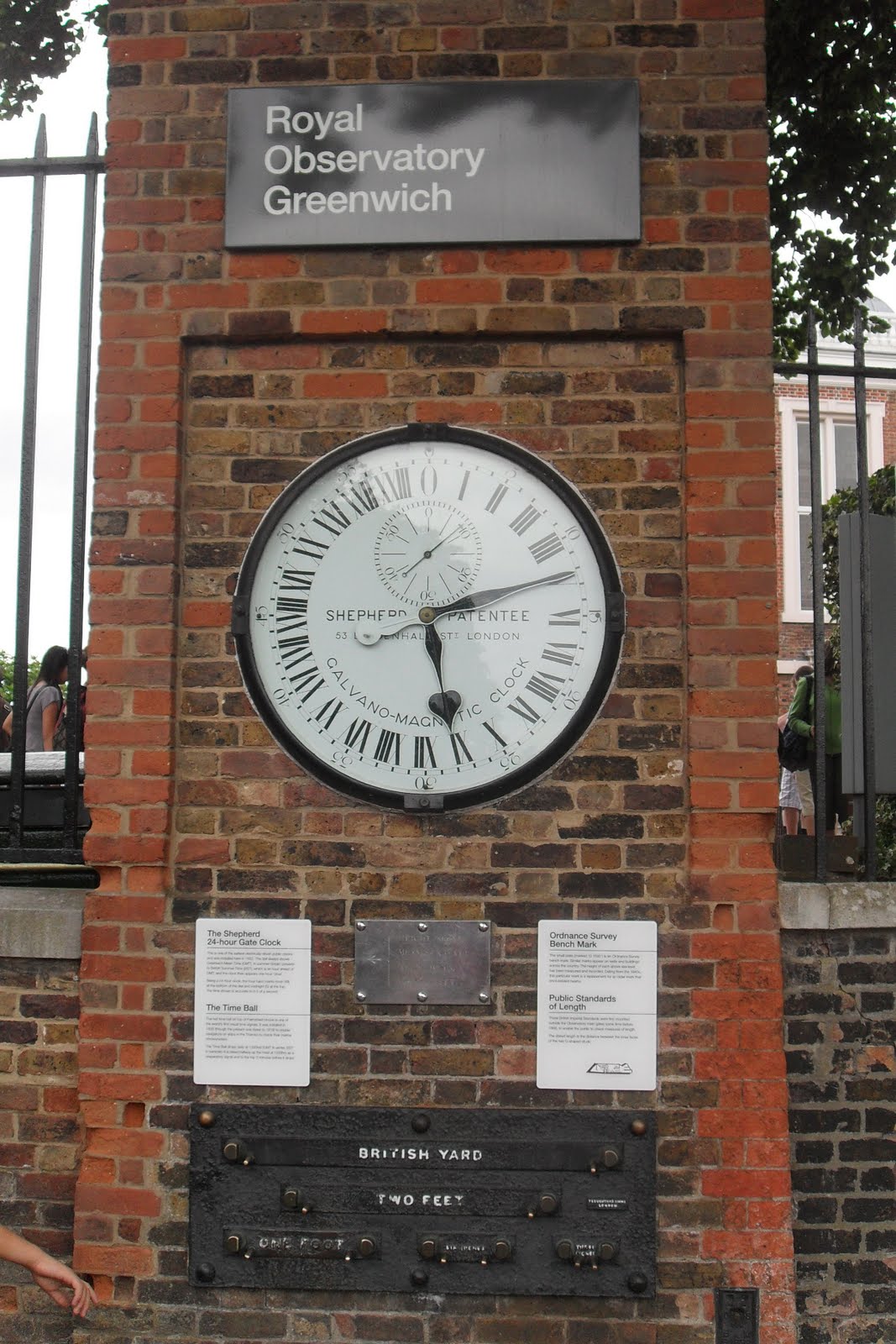
The Royal Observatory in Greenwich is the home of Greenwich Mean Time (GMT) and the Prime Meridian of the world.


The jewel of their collection, at least for me, was Harrison's 1759 prize-winning longitude watch called H4 (for his fourth watch). H1, H2 (was out for conservation work) H3 and H4 were all on display here.  There is an interactive display that reminds me of the British Library's Turning the Pages digitization of objects for a closer look. Also on display was Harrison's Regulator that only lost one second in 100 days.  His closest competition lost 1 second per seven days!  After reading Dava Sobel's Longitude this was a highlight to experience since I did not go here last year.  


The Time Ball

This is the Flamsteed House, the original Observatory building at Greenwich. Designed by (guess who) Sir Christopher Wren and Robert Hooke, it was built in 1676 for the first Astronomer Royal, John Flamsteed.  The ball on top was first used in 1833 to tell time for ships on the Thames.  At 12:55 the ball begins to rise, and falls at exactly 13:00.


 I'm on one side of the hemisphere. Now I'm on the other!  Every location is measured in terms of its distance east or west from this line.


Visit their site at http://www.nmm.ac.uk/places/royal-observatory/