Friday, 9 July 2010

American Library in Paris

Literature. Learning. Culture. Community


In the midst of being lost in language, The American Library in Paris was like a little slice of home.  This subscription library opened in 1917 in order to serve U.S. service personnel.  It was founded by the American Library Association.  In 2009 the library expanded the reading room and increased their computer access.  The collection has grown to offer over 120,000 books, 300 periodicals, multi-media, online databases, programs, a bi-weekly e-newsletter that reaches over 4,000 patrons, and more.   I found it interesting that this was the first library on the continent to offer Braille books in English in 1955. During the months of July and August the library is closed on Sundays. 

According to their Web Site, their vision and mission is as follows,

Vision

The American Library in Paris celebrates the written word and the life of the mind. It is constantly renewing its purpose in Paris as a center for literature, learning, culture, and community.

Mission

  • To provide access in France to what is best in English-language books, periodicals and other materials by sustaining and extending a varied and enduring collection.
  • To provide the services of a contemporary American public library.
  • To encourage and support reading in English by children and young adults.
  • To act as an educational support center for people of all ages on their pursuit of formal instruction or personal growth.
  • To promote better understanding between France and the United States by making available the artistic, historical and business record of the American experience to an international audience.
Our group had a brief tour of the library.  I was invited back to help with activities in the children's department the next day, however I was already booked on another tour.  The children's room was small but comparable to other UK and US libraries.  It seemed like a great learning environment for children.  There are 10,000+ books, 1,000 audio visual items, 15 magazine subscriptions and programs for all ages.  Story time readings are called "Lap Sit" for 1-3 year olds.  There is no registration for programs unless they are for special events.


On one of the brochures there is a picture of the Statue of Liberty, with the Eiffel Tower in the background, reading a book titled American Library in Paris.  They have clever marketing and outreach to promote their services.  Outside of the library was a cart full of books all marked FREE.  Our professor thought we were going to town buying books, not realizing they were marked free.  I added a few quick summer reads to my collection and then ended up donating them to another library before leaving the UK.  


I think it is very important for Americans to have a library like this in a foreign country.  I was only in Paris for a few days, and felt pretty overwhelmed with the language barrier and being out of the loop from American happenings.  This is a great place to go for American materials.  Even though it is a subscription library, it is well worth the rate if you consider how much it cost to purchase books, DVDs, magazines, newspapers, etc.  I know I would rather give my business to a library than a book store any day of the week.


Visit their site at http://www.americanlibraryinparis.org/

Wednesday, 7 July 2010

British Museum Archives tour

This year our class was fortunate enough to take a tour of the central archives at the British Museum.  Stephanie Clarke, the Museum Archivist, offered us a behind the scenes tour that winded through the basement of the museum.  Here we saw some pretty important documents and learned about the way information is arranged and preserved.  There are eight archival departments, divided by geographic location of the major collections.  While not all departments have professional Archivists, Stephanie and her staff help them where they can and provide advice as needed.  The archives team are not actually a part of the library, however they are considered to be part of legal services.  This includes records management, freedom of information and data protection, among other aspects.  

Archival documents include a series of six subjects; governance, staff records, finance, building plans, temporary exhibits and records of objects.  These are all documented and saved in books dating back to the foundation of the museum in 1753.  Since preservation is always a concern the information has been transferred to microfilm, which is how the general public usually accesses it.  Since 1753 there has been a book to document donations as well as a book of letters to and from the director. 

The archives collection holds about 8,000 pictures of which we were shown a few of the most fascinating.  Particularly, the photos capturing the destruction from WWII were really devastating, as well as a bomb shell that was found at the museum. Interestingly, this shell is not part of the collection! 

The Natural History Museum archives are also housed in this location since it started here at the British Museum.  There are photos proving how packed the collection was, it is no wonder they had to start a new museum!

Years ago, potential patrons had to supply a letter of reference with their application.  An interesting application we studied was that of a Mr. Thomas Stearns Eliot, for those who know the name!  What is so fascinating about this is that it records all of the addresses where he lived while abroad as well as his intended course of study at the library.  The American Consular wrote his letter of recommendation and cited him a student at Oxford.  We were also shown the signature card for Karl Marx from 1918. 

Ah, the British Museum...


Upon entering the Great Court, pictured above, visitors are greeted by the seven ton Lion of Knidos. Once guarding a tomb on a cliff in Turkey, this colossal marble monster is believed to be from 370-350 BC while others date it around the 2nd century BC.  Either way, massively impressive and a sight to see, it was 'discovered' in May of 1858 and brought to the British Museum.  What interests me in this lion is that the marble to make it travelled across the Aegean Sea from Mt. Pentelikon, near Athens.  What a journey this marvel has endured and the only loss was his eyes, lower jaw and front paws.

Moving on, my next goal was to find this giant arm that I took a picture with last summer.  In keeping with tradition, I had to have another photo.  I learned this time around that this arm is desperately holding onto a container for documents.  It comes from a statue commemorating a king of the Eighteenth Dynasty, about 1390 BC (?). 


Here is the rest of him, so you can realize just how massive it all is:


Outside of the museum there is a recreation of a lush African landscape.  Besides for the apparent natural beauty, I was struck by the description of the landscape.  Everything has another purpose...nothing is wasted.  How did they learn, for example, that the coleonema pulchelllum, or the confetti bush, is a natural insect repellent?! 

Who was the unfortunate soul who discovered this:

Looks good enough to eat, and similar to other plants or flowers that are edible...!

Other fauna is used to treat hard corns, warts,  and boils.  Sap that is poisonous to eat is used to make rubber.  Some are used in traditions such as charms to help crops.  Others like the dioscorea elephantipes, or elephant's foot, is used in multiple ways; medicinal as well as fermenting it to use as a yeast to bake bread.  This was a very interesting perspective and a lovely outdoor exhibit. 

Visit the museum at http://www.britishmuseum.org/

They have a great gift shop! Last year I bought a CD that has the sounds of London...saved it for a long time before listening to it (with a big smile on my face)!

Tuesday, 6 July 2010

The Clockmakers' Museum

Photo courtesy of http://www.clockmakers.org

The photo above captures The  Harrison case.  It contains the famous "H5" clock that John Harrison perfected to solve the problem of longitude.  The cases across contain works by Mudge, Arnold, Earnshaw and other influential clock makers.  

The Library and Collection are funded by the Clockmakers’ Museum and Educational Trust. There is a part-time consultant keeper. The Guildhall Library, where the Museum is located, manages the collection on a daily basis.  


See manuscripts, drawings, and more at http://www.clockmakers.org/?page_id=58

Barbican Public Library


The Barbican Library is located within a community of about 9,000.  Its service area includes the square mile of the "city" of London in which 350,000 people work!  There is a school of music and drama close by that utilizes the collection, however the Barbican Library does not cater to their curriculum.  For events and programs, they sometimes work in conjunction with St. Giles church one of the only local building not destroyed during WWII.  This does, however, cause some friendly rivalry in terms of book sales! 

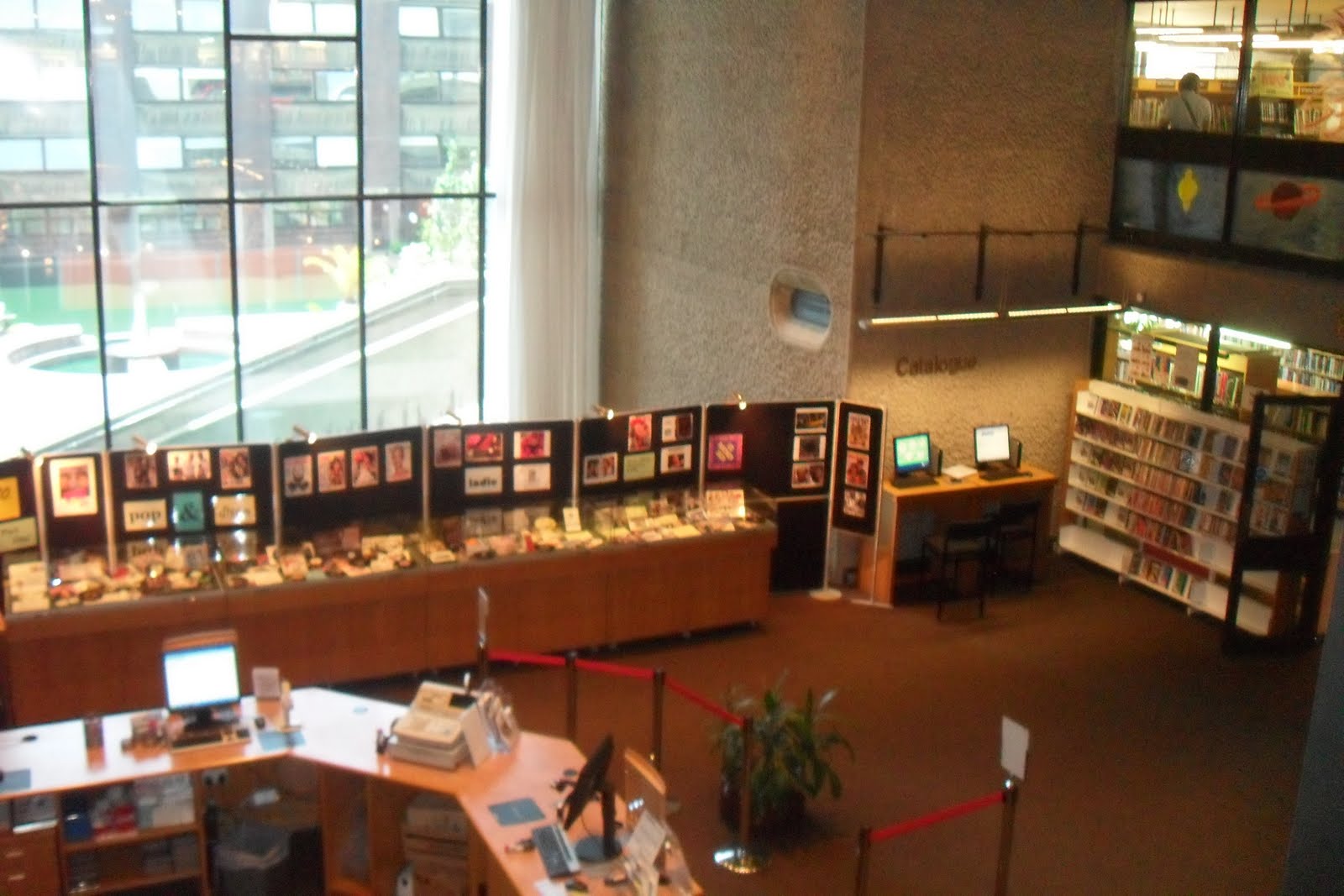
Below is a bird's eye view of the Music Library at the Barbican.  Although it is a general public library, there is a focus on the arts and this is a very strong department- and one of the few that has a chartered Music Librarian.  The exhibit you see along the wall is actually made up of his personal collection! Along with score sheets and reference materials, there are rows and rows of CDs arranged to look better than a Best Buy.  Something that is interesting and different than the U.S. is that items like world cinema DVDs rent for 2.75 per week and music for 2.50, payable with credit or debit.  This, I think, is a great idea for more than one reason.  My local movie rental store went out of business.  I will never purchase a movie, dvd, book, magazine, newspaper, etc, ever again!  Charging for items like this at the library will not only increase library funds, which face it- is greatly needed these days, but it will also protect local businesses who can't compete with the library's free services.  There is a 3 month rule on new CDs that come out, they can only be listened to inside the library.  This is to stop people from renting the new CD and burning it (within the first 3 months). 


The following photo captures a lot of what is interesting at this library.  The librarian, John Lake, is hilarious as well as very knowledgeable.  Sometimes the public views the library in general as a boring, harsh place.  Librarians like John Lake and everyone else at the Barbican are changing that perception, one patron at a time.  If all librarians could take a page from this book, I think more people would utilize the services at their local libraries.  In his hand, he holds a remote RFID that is not in use at this time.  The library is set up for RFID - self checkout, however some patrons do not know this service is available because the set up is built into the current checkout counters so well that it is barely  noticeable.  The only issue they come across is scanning items like CDs and DVDs and items like Yoko Ono's book that has a foil cover!
                                                          
Side note: John is also responsible for something that I have been admiring since I arrived in London this summer.  Some of the tubes have 'Music Poems on the Tube' blurbs, pictured below.  Fitting since this library boasts one of the largest music libraries with over 16,000 CDs, listening booths, music tabs and much more.  There was one that had a few lines from the Tempest that described my feelings of summer in London this year...It was really interesting to me to see a librarian's work in action.


Visit http://www.cityoflondon.gov.uk/corporation/LGNL_Services/Leisure_and_culture/Libraries/City_of_London_libraries/barbican_lib.htm

Monday, 5 July 2010

Greenwich Maritime Museum, Caird Library

National Maritime Museum, Caird Library:


The library is moving from its original location where it has been in operation since 1937.The rotunda is the only room that will be kept in its original condition.  The new library will better house the collection of immigration, piracy, navigation, astronomy, exploration, naval architecture, Merchant and Royal  Navy as well as geneological resources.  Although the library has been previously redesigned to allow for more readers, the musuem now needs this area for a gallery, and the library needs a larger space.  To give patrons access to the rare books, it is necessary to have a sight line on readers to ensure they are handling the books in the proper manner.  In the span of roughly one year despite being opened limited hours, there were over 2,000 visitors in the library.  Keep in mind the current library is basically hidden from the public- locked behind fire doors.  Patrons must be 16 years of age to use the resources.  Imagine the possibilities when the new library opens! In addition there will be more modern software to allow for online orders. 

The "gems" of the collection include over 8,000 rare books, pre 1850.  The modern books (post 1850) consist of over 100,000 titles. 


Set of Signals from the US Frigate Chesapeake- 1810
Lead in spine so book would sink if it needed to be thrown overboard. 
Ship set sail from Bosten and lost a15 minute duel vs. Britain.
After this loss, the American Navy had to change their codes!
This is where the term "don't give up the ship" originates.  Interesting...


Notice something funny about this map?


Visit their collections online at http://www.nmm.ac.uk/explore/collections/by-type/archive-and-library/

British Library tour


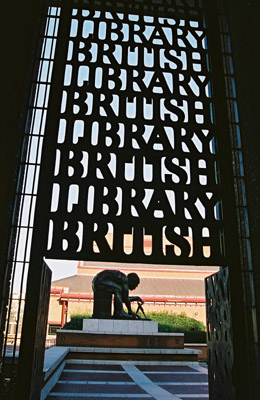
While not much has changed in terms of the tour of this National depository library, it is a place that will never get old.  The collection began at the British Museum in 1753 and officially opened at the current location in 1998.  Design began in 1962! It is the biggest public building in the United Kingdom and the busiest research library.  This year we had a glimpse at the delivery room where a one mile long system carries books and delivers them to the appropriate reading room. 

I learned some new facts about the library from our tour guide, Chrissy-who was very knowledgable.  I found it funny that the balcony that overlooks the King George the 3rd's Library is known as Scholar's Leap.  It offers the best view of the library and showcases how massive the stacks of the King's Library are, from floor to ceiling.  It was interesting to learn that if books get wet from the sprinklers (which is better than burned) they will blast freeze them to dry them out.  She said she pictures Tesco's emptying out their frozen peas to make room for the rare manuscripts, like the 10th century manuscript of Beowulf! Something that was pretty incredible to see is the world's largest atlas.  Last year it was closed behind glass, but now it is open on display as part of an exhibit, Magnificent Maps.  I was wondering how mangificent they can truly be, let me tell you- it was incredible.  I've never seen such varying types, sizes and representations.  There were huge map tapestries from 1590...wooden pocket globes from the 1670s,  medieval maps from 1390 that convey their version of the history of civilization, progaganda map posters, and more.  Magnificent, to say the least.


This lovely area allows readers to relax in the garden and get some fresh air. Not that we don't all love the smell of old books :)  


Visit their incredible site at http://www.bl.uk/

Be sure to check out their page for Treasures in full.  Flip through the virtual pages of history.

St. Paul's Cathedral Library


Cathedral Library
This library is in the process of cataloging their collection into a database,although it will not be web-based.  It is 85% complete and takes even longer than expected because they do not 'copy catalog' or import from OCLC.  Doing so would create what Joe Widsom refered to as "noise".  Noise refers to copy specific data that makes each monograph unique.  Each item has its own valuable provenance, and individually cataloging an item will retain that exceptional value. 

An interesting note Mr. Widsom spoke of in terms of special collections is rule #1 and rule #2 - never get rid of an outdated catalog.  Although this seems like something a library would weed, as an old catalog is not useful for patrons, it showcases the progression of the collection. 

The earliest item in the collection is a 12th century Book of Psalms.   

Visit their site at http://www.stpauls.co.uk/